Bucknell University · Senior Design for P&G
Automated Plate Cleaner
I worked on a mechanical engineering senior-design team developing an automated approach to cleaning the printing plates used on P&G paper towels. The system needed to remove residual ink while protecting the photopolymer surface and making useful use of shop-floor space.
- Project context
- Bucknell mechanical engineering senior-design team for P&G.
- Design challenge
- Balance cleaning quality, surface damage, capacity, and floor space.
- Outcome
- A working cleaning prototype supported by cleaning and surface-damage evaluation.
01 / Development
Understanding the printing process
Decorative paper towels are printed using ink-covered plates. The cleaning system needed to remove residual ink without damaging the photopolymer surface or consuming excessive shop-floor space.
02 / Development
Testing cleaning methods
The team compared rotating brushes with high-pressure water. Cleaning performance and abrasion were evaluated visually, with scanning electron microscopy and MATLAB image analysis used to examine surface damage in more detail.
Cleaning approaches
Cleaning result
Surface damage
03 / Development
Choosing a practical architecture
Concepts were considered against cleaning capacity, occupied floor area, complexity, and the semester schedule. The selected brush-based approach provided an architecture the team could develop into a working physical prototype.
04 / Development
Building the prototype
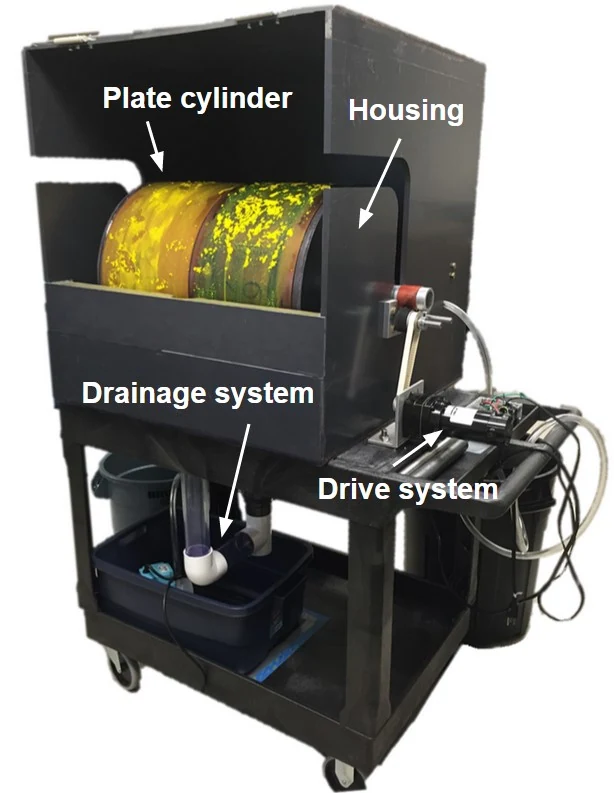
The system integrated a CNC-milled foam basin with a water-resistant coating, 3D-printed handles for controlling brush pressure, and motor-driven friction rollers for rotating the plate cylinder.
05 / Development
Defining the cleaning sequence
The cleaning sequence combined soaking, brushing with solvent spray, and drying. A later development concept enclosed the cleaning zone and supported four cylinders driven by two motors.
The working prototype demonstrated the selected cleaning architecture. The enclosed, multi-cylinder arrangement remained a future-development concept.