Bucknell University · Research with Professor Craig Beal
Autonomous RC Vehicle
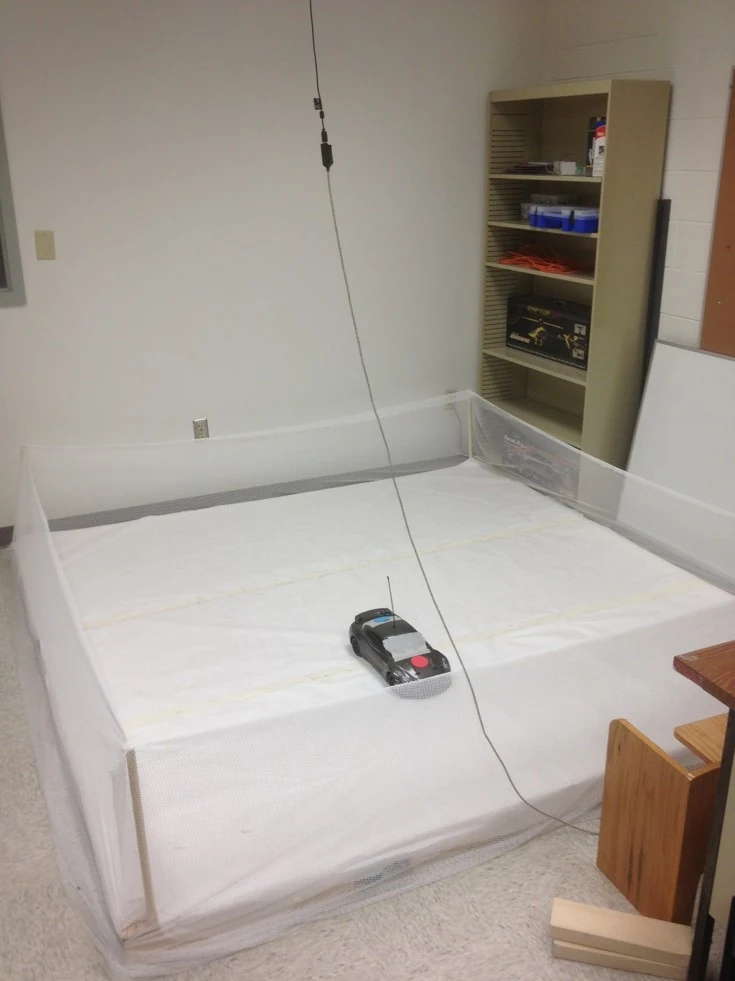
This research used a scaled RC-car platform to investigate autonomous steering. Overhead-camera tracking, Arduino actuation, and steering algorithms were brought together in a physical test environment.
- Project context
- Controls research under Professor Craig Beal at Bucknell University.
- Engineering challenge
- Connect measured position and orientation to physical steering behavior.
- Outcome
- Physical tracking and steering experiments; one trial averaged 1.15 m/s.
01 / Development
Building a measurable test platform
A ceiling-mounted webcam viewed a white test surface. Red and blue markers on the car supported color filtering and circle identification, allowing its position and orientation to be tracked at up to 30 frames per second. An Arduino interface controlled speed and steering through the RC controller.
01 / Observe
Overhead camera
Capture the vehicle and its red and blue tracking markers.
02 / Estimate
Position & orientation
Identify the markers and calculate the vehicle’s relationship to the track.
03 / Actuate
Speed & steering
Send commands through the Arduino interface to the RC controller.
02 / Development
Closing the steering loop
The initial controller used distance and heading error relative to a circular track. Physical tests connected the steering calculations to the car’s actual motion.
03 / Development
Expanding the virtual track
The method was extended to calculate the track’s tangent angle at each point. Feed-forward steering anticipated each turn, while feedback corrected the vehicle’s orientation and distance from the track. Physical tests connected the algorithms to the car’s actual motion.
04 / Development
Testing at higher speed
A further feedback method used a projected point ahead of the vehicle. One physical trial averaged 1.15 m/s.
At approximately 1.1 m/s and 30 frames per second, the car moved about 37 mm between camera observations. This made the relationship between measurement timing, speed, and steering behavior visible in the physical tests. Predicting position between frames was identified as a direction for further research.